




Did you know that a deaf dog can learn almost all the same cues as a hearing dog? In deaf dog training, the key is not your voice. It is finding a different way to communicate with your dog.
When you discover that your dog is deaf, it is natural to have lots of questions. How will I teach them to sit? How will I get them to come back when I call? Can they walk safely? Will training be harder?
The good news is that deafness does not stop a dog from learning, enjoying a full life and building an extraordinary bond with its family. Your dog simply needs training adapted to the way it perceives the world.
At Dirty & Happy, we know that training a dog is not just about teaching commands. It is about understanding your dog, building trust and learning to communicate in a way you both understand.
A deaf dog doesn’t need to hear you to understand you
Dogs are great observers. Even hearing dogs constantly read our body language to understand our intentions, emotions and movements.
For a deaf dog, this ability becomes even more important. Instead of responding to words such as “sit”, “stay” or “come”, your dog learns to link visual signals and specific gestures with particular actions. For example:
- A raised hand can mean “stay”.
- A downward movement of the hand can mean “lie down”.
- An inviting gesture with your arms can be used to call your dog.
- A specific visual signal can tell your dog it has done something right.
There is no compulsory universal sign language for dogs. What matters is that your gestures are clear, easy to recognise and always used in the same way.
And here lies one of the most rewarding parts of training a deaf dog: the dog learns to understand its owner, and the owner also learns to understand the dog.
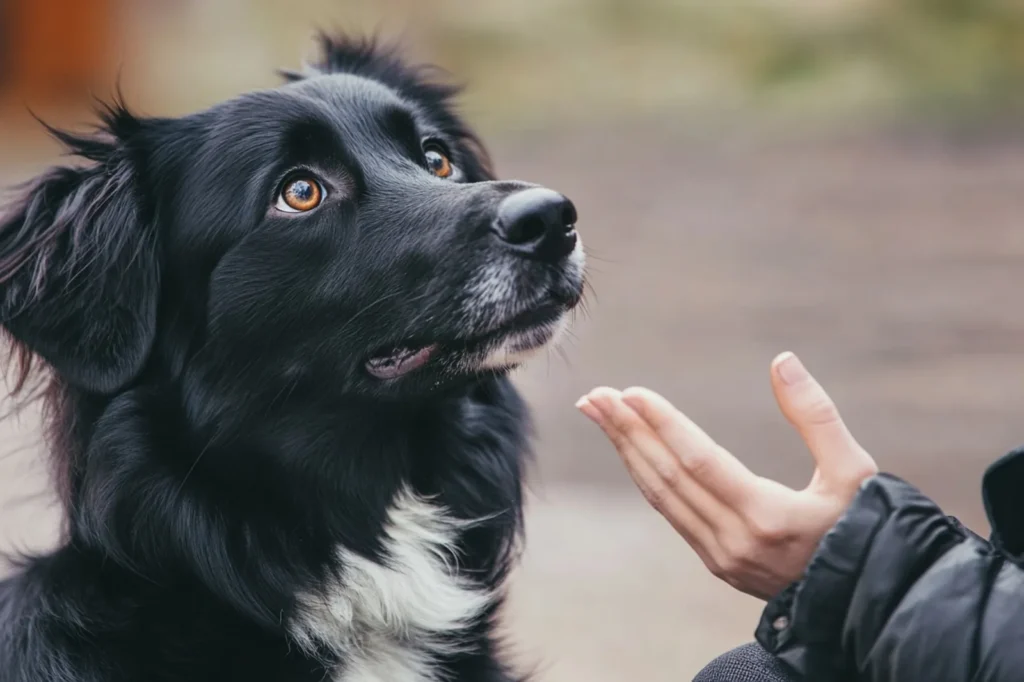
The first big challenge: teaching your deaf dog to look at you
Imagine trying to teach something to a person who cannot hear you while they are looking the other way. With a deaf dog, the situation is similar.
Before teaching any cue, we need to develop one essential skill: your dog must learn to pay attention to you. This is the starting point for everything else.
Through connection exercises and positive reinforcement, your dog learns that looking at you leads to good things: a treat, a stroke if they enjoy it, or a chance to play.
Little by little, your dog starts to seek eye contact on its own. This simple-looking skill opens the door to everything else.
A dog that looks for your eyes is a dog you can communicate with, without saying a single word.
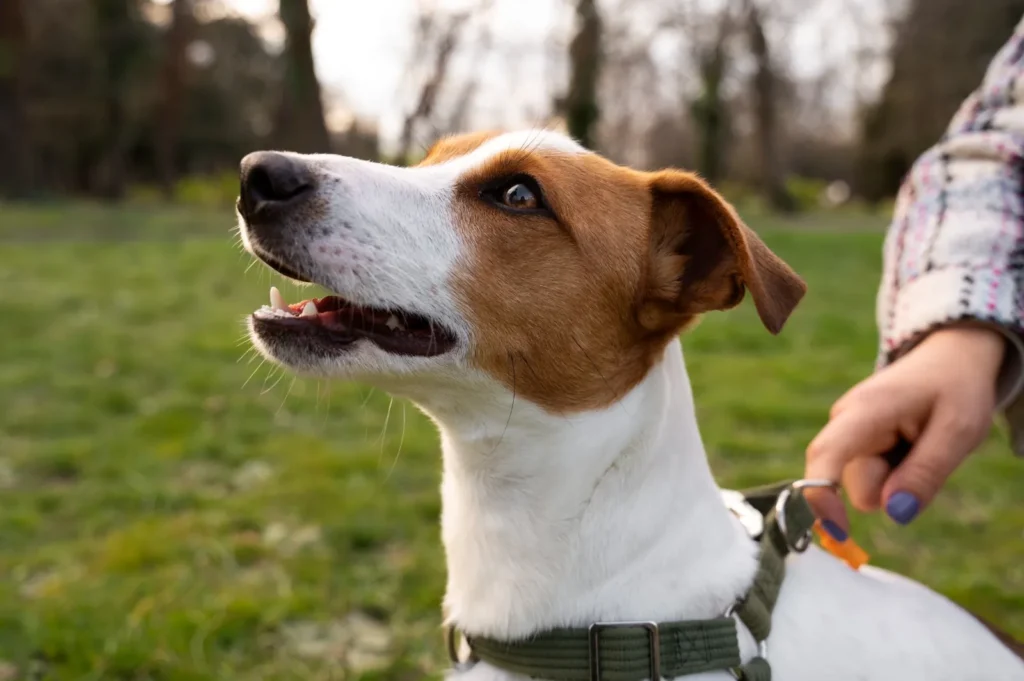
Learning to observe: the other half of communication
Training a deaf dog is not only about getting it to respond to your gestures. You also need to learn to read its body language.
Ear position, muscle tension, body orientation, tail movements and the way your dog scans its surroundings all tell you how it feels. A dog can be unsure, relaxed, excited or worried without making a sound.
Recognising these signals helps you adapt each session and avoid situations that cause stress.
Deaf dogs also tend to pay close attention to visual information, touch and vibrations around them. Some may startle when someone appears suddenly or touches them while they are resting. That is why the whole family should learn to approach calmly and predictably.
Patience, observation and respect for your dog’s emotions are just as important as any obedience exercise.
Five tips for living with and training a deaf dog
If you share your life with a deaf dog, these tips will help you improve your everyday communication.
1. Always use clear, consistent signals
Avoid changing your gestures all the time. If the whole family uses the same signals, your dog will find it much easier to understand what is expected.
2. Reward eye contact
Every time your dog looks at you spontaneously, reinforce that behaviour. Voluntary attention will be an essential tool for the rest of its life.
3. Don’t startle your dog while it is resting
Avoid waking your dog abruptly. Approach so that it can sense you coming, or use gentle, predictable vibrations, as long as you have first checked that they don’t frighten it.
4. Practise in quiet places first
Start exercises somewhere with few distractions and increase the difficulty gradually. Remember that your dog needs to see you to understand many of your signals.
5. Pay special attention to safety
A deaf dog cannot hear an approaching car or respond to a verbal recall when it is facing away. That is why distance attention and a visual recall are essential. Until you have reliable control, practise in safe, enclosed spaces and use a long line when needed.
When should you start training a deaf puppy?
The sooner you build good communication, the easier it is to develop good habits. At Dirty & Happy, we offer an individual programme for young deaf dogs in two complementary stages, alongside our work with puppies.
Stage one: from two months of age
In the first months, we focus on building the foundations of the relationship between the puppy and its owner. The work includes:
- Developing attention and eye contact.
- Building a bond of trust.
- Introducing the first hand signals.
- Basic training suited to the puppy’s age.
- Observing how the puppy responds to its environment and emotions.
- Step-by-step learning with positive reinforcement.
We choose the gestures together with the owner, considering both what feels natural for them and how easily the puppy understands each one. If a signal doesn’t work well, we change it.
The aim is not to force the dog into a rigid system, but to find a way of communicating that works for both of you.
Stage two: from around nine months
As the puppy grows, its maturity, reactions and relationship with the environment change too. In this second stage, we build on what it has learned and focus on:
- Attention to the owner at greater distances.
- Responding to visual signals around distractions.
- A visual recall and returning to the owner.
- Self-control and confidence in different situations.
- Safety on walks and in everyday activities.
The goal is to give the dog and its family increasingly reliable communication tools. Even if the puppy learned quickly in stage one, stage two is still important to consolidate its skills and apply them to new situations.
What if my deaf dog is already an adult?
It is never too late to learn. An adult dog can develop new skills and communicate better with its family, even if it has never had specific training.
The first step is to assess what the dog already knows, how it responds to signals and what its relationship with its owner is like. If it already knows some gestures and has a good foundation, we can move on to more complex exercises. If not, we start with the basics: attention, connection, simple signals and trust.
Every dog has its own story and learns at its own pace. That is why the programme is adapted to its real needs.
Why we recommend one-to-one sessions for deaf dogs
At Dirty & Happy, we train deaf dogs through one-to-one dog training sessions, because we believe it is essential to respect each dog’s sensitivity and learning pace.
This format lets us observe the dog’s reactions, adapt the exercises, choose the most suitable hand signals and work directly with the owner.
Family involvement is essential. The aim is not for the dog to respond only during a session with the trainer, but to understand the people it lives with every day. Real training continues at home, on walks, during play and in every small daily interaction.
A different way of listening: with your eyes and with trust
Living with a deaf dog can teach us something very valuable: communication goes far beyond words. A look, a gesture or a movement can convey trust, security and affection.
With patience, understanding and the right training, a deaf dog can fully enjoy walks, play, family life and a balanced home.
A dog doesn’t need to hear our voice to understand us. It needs us to find the right way to communicate with it.
Do you have a deaf dog and want to communicate better?
At Dirty & Happy, we offer individual dog training tailored to each dog’s needs, with a special focus on the bond with its owner, hand-signal communication and positive reinforcement.
Whether you have a deaf puppy or live with an adult deaf dog, we can help you build clearer, safer and more effective communication.
Contact Dirty & Happy and find out how we can help:
- 📞 Phone: 617 117 151
- 📝 Dog training contact form
- 📍 We are about 1 km from Ciudad Quesada, on the road to San Miguel de Salinas (Alicante).
Dirty & Happy: training, trust and wellbeing for your dog.


